A profitable business can still face a cash crisis. Revenue may be growing while customer collections slow, inventory absorbs working capital, tax payments approach, or a major supplier requires earlier settlement. A 13-week cash flow forecast gives management a practical view of these pressures before they become urgent.
Management takeaway
The value of a 13-week forecast is not the spreadsheet itself. It is the weekly discipline of testing assumptions, assigning actions, and making decisions early enough to preserve options.
Why 13 weeks?
Thirteen weeks is long enough to reveal the effect of collection patterns, payroll cycles, supplier commitments, debt service, taxes, and one-off payments, yet short enough to forecast with operational detail. It bridges the gap between a daily bank balance and an annual budget.
A good model helps management answer practical questions: When is the lowest cash point? Which receipts are critical? What payments can be rescheduled without harming operations? Will an expected funding facility arrive before it is needed? How much headroom is available if sales or collections miss plan?
Unlike an accounting cash flow statement, the forecast should be built around the timing of actual bank movements. Its purpose is control and decision-making, not simply financial reporting.
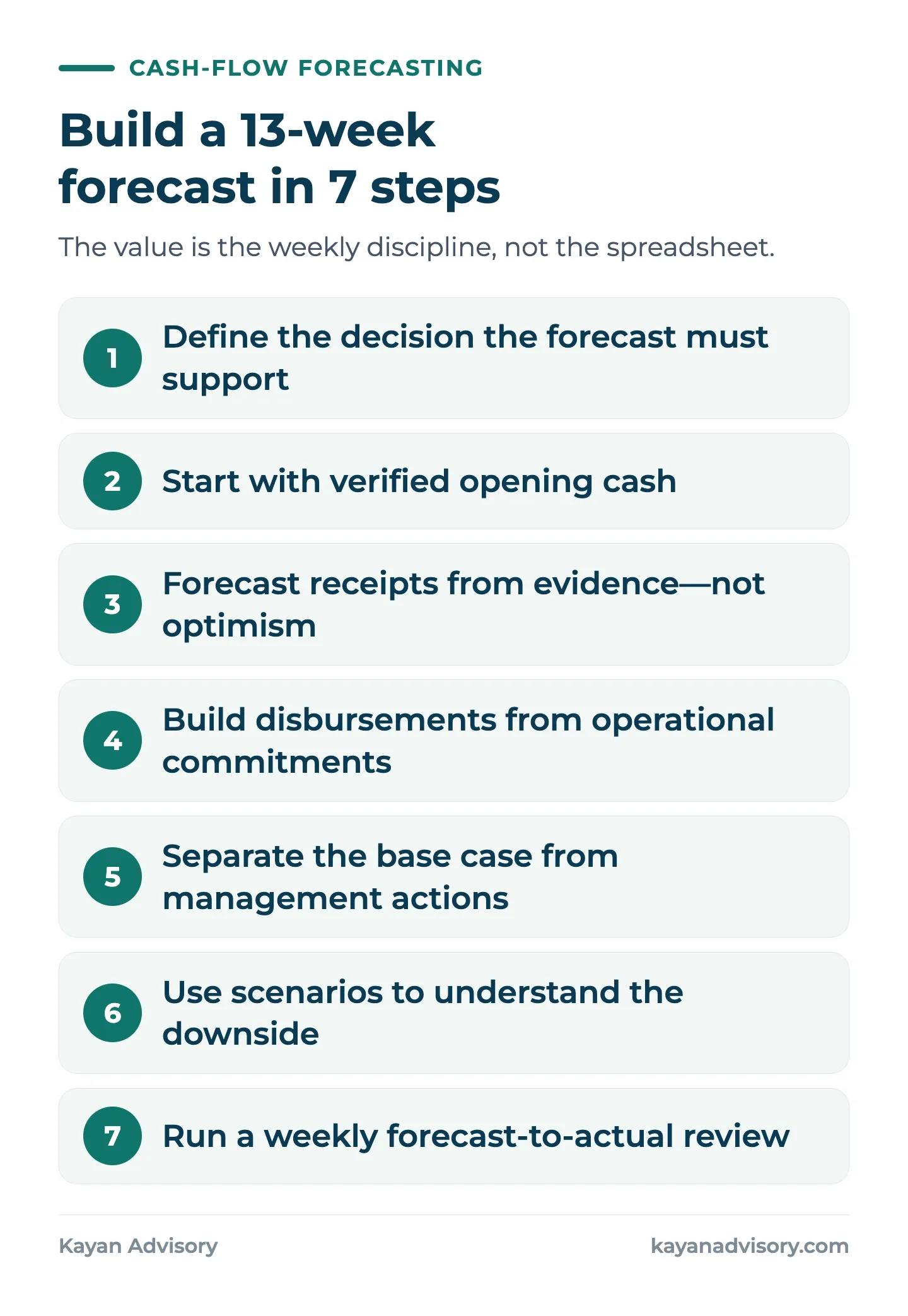
1. Define the decision the forecast must support
Before opening a spreadsheet, agree what management needs from it. A company managing rapid growth may focus on inventory purchases and receivables. A business approaching a financing discussion may need to demonstrate its minimum cash requirement and repayment capacity. A turnaround situation may require payment prioritisation and daily follow-up on critical receipts.
Define the entities, bank accounts, currencies, and cash categories included. Identify the minimum operating cash buffer and the people responsible for supplying and approving assumptions. A precise scope prevents the forecast from becoming a large model that nobody fully owns.
2. Start with verified opening cash
The first line should reconcile to accessible cash in the bank at the start of week one. Separate restricted balances, undrawn facilities, post-dated instruments, and cash that cannot be used for normal operations. Treat a facility as a financing option until it is contractually available and the drawdown conditions are understood.
If opening cash is wrong, every ending balance will be wrong. The forecast owner should therefore reconcile it to bank statements and explain any difference between book cash and available cash.
3. Forecast receipts from evidence—not optimism
Customer receipts are usually the most important and uncertain input. Begin with the receivables ledger, then assess each material balance using invoice due dates, customer behaviour, disputes, delivery milestones, and the commercial team’s current information.
For large or concentrated customers, forecast at invoice or customer level. For smaller recurring balances, a collection pattern may be appropriate. Keep expected sales separate from the conversion of those sales into cash, and do not automatically assume that revenue booked this month will be collected within the forecast horizon.
Useful receipt categories
- Existing trade receivables
- Cash sales and new invoicing collections
- Deposits, advances, and milestone payments
- Tax refunds or other operating receipts
- Asset sales, shareholder support, or financing proceeds
4. Build disbursements from operational commitments
Use payroll records, supplier ageing, purchase orders, lease schedules, tax calendars, debt agreements, and approved capital expenditure rather than applying a percentage to historical costs. The forecast should show when cash is expected to leave the bank, including the effect of payment terms and approval timing.
Group payments in a way that supports action. Payroll, critical suppliers, rent, taxes, debt service, capital expenditure, and discretionary spending should not be hidden inside a single operating-cost line. Management needs to see which payments are fixed, which are essential to continuity, and which may be deferred or renegotiated.
5. Separate the base case from management actions
A forecast becomes misleading when hoped-for interventions are embedded in the base case. Show the expected operational position first, then identify actions separately—for example accelerated collections, negotiated supplier terms, delayed capital expenditure, cost containment, asset disposal, or new financing.
This separation shows the underlying cash requirement and prevents the same improvement from being counted twice. Each action should have an owner, a target date, an estimated cash effect, and a clear status.
6. Use scenarios to understand the downside
A single case can create false confidence. At minimum, test a base case and a downside case. The downside does not need to be dramatic; it should reflect credible risks such as delayed collections, lower sales conversion, an earlier supplier payment, an unexpected tax obligation, or a financing delay.
The objective is to identify the earliest week in which liquidity becomes constrained and the amount of additional headroom required. Scenario analysis is most useful when it leads to pre-agreed triggers—for example, when to freeze discretionary spending, escalate customer collections, or begin a financing process.
7. Run a weekly forecast-to-actual review
Every week, replace the completed week with actual bank movements, add a new week at the end, and explain material variances. Was a customer payment delayed? Did payroll differ from plan? Was a supplier payment brought forward? Was a receipt entered twice or assigned to the wrong week?
Variance analysis improves the next forecast and exposes weaknesses in operational information. Over time, it also shows which assumptions are dependable and where management needs stronger commercial or financial controls.
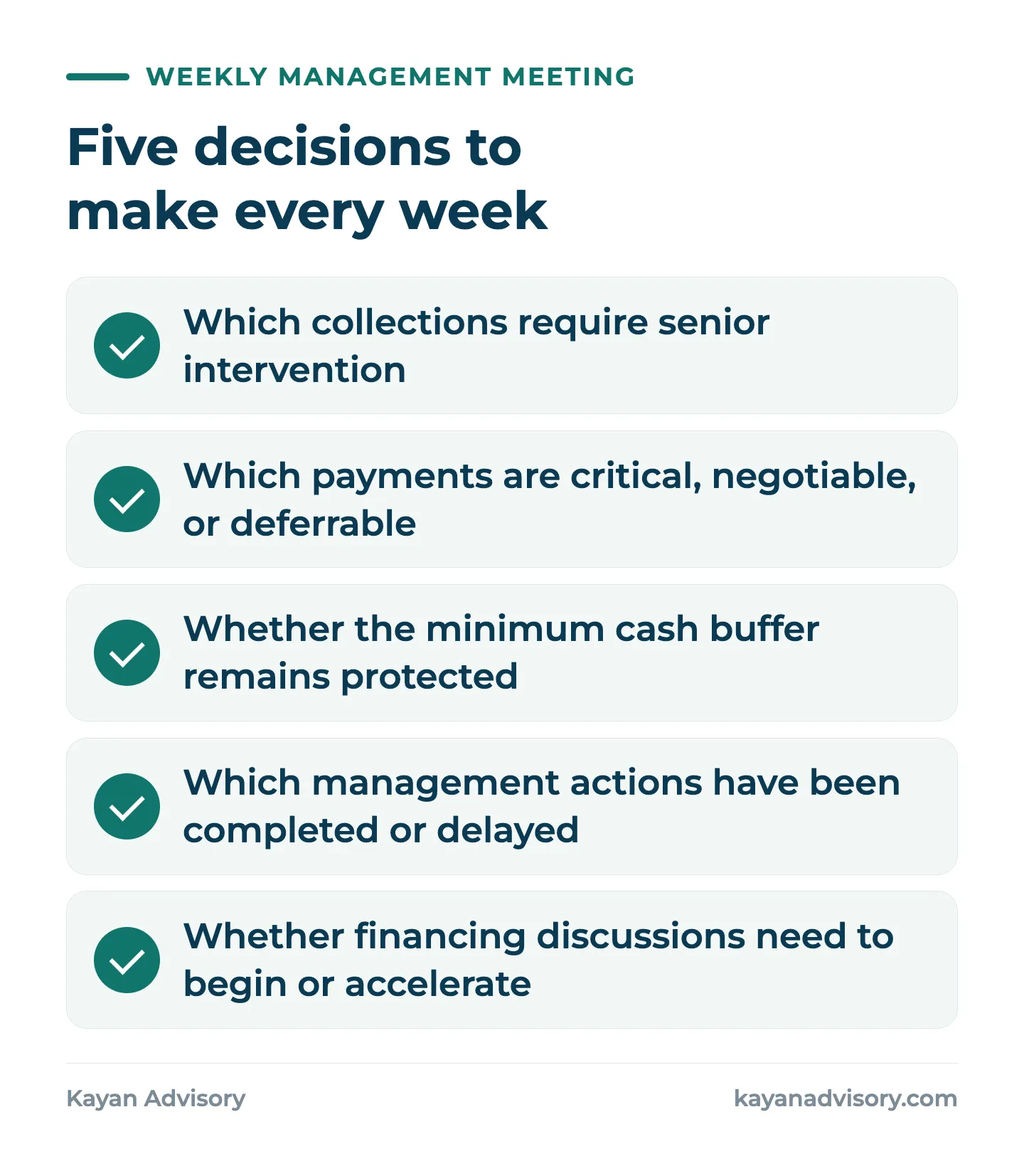
The weekly management meeting should decide:
- Which collections require senior intervention
- Which payments are critical, negotiable, or deferrable
- Whether the minimum cash buffer remains protected
- Which management actions have been completed or delayed
- Whether financing discussions need to begin or accelerate

Common mistakes that reduce forecast value
Using profit as a proxy for cash.
Accounting recognition and bank timing are different.Treating every receivable as collectible on its due date.
Customer behaviour and disputes must inform timing.Hiding uncertainty in aggregated lines.
Material receipts and payments should be visible and traceable.Updating the model without assigning actions.
A forecast should drive accountable decisions, not become a reporting ritual.
A practical structure for the model
Keep the model transparent enough for another team member to review. A useful structure contains an assumptions and controls sheet, detailed receipts, detailed payments, a 13-week summary, scenarios, and a management action tracker. Link totals back to source schedules and use clear flags for overdue inputs, negative headroom, or material changes.
Complexity should be earned. Begin with the lines that drive liquidity, then add detail only when it improves a decision, ownership, or control.
From cash visibility to better decisions
A well-managed 13-week forecast gives owners, boards, and finance teams a shared view of near-term liquidity. It supports earlier conversations with customers, suppliers, lenders, and shareholders, and it makes the financial effect of operational choices visible before commitments are made.
The model will never predict every movement perfectly. It does not need to. It needs to be sufficiently evidence-based, frequently updated, and closely connected to management action.
Strengthen your cash-flow discipline
Need a forecast that management can use every week?
Kayan Advisory helps businesses build practical cash-flow models, establish a weekly review rhythm, test downside scenarios, and translate liquidity insight into clear management actions.
This article provides general business information and does not constitute financial, tax, or legal advice. The appropriate forecasting approach depends on each organisation’s circumstances.