Start Smart with Odoo: A Practical Platform for New and Small Companies
Need help setting up Odoo? Kayan Advisory helps new and small companies set up and run Odoo. Book a consultation. Disclosure: Kayan Advisory receives no referral commission on Odoo subscriptions until ten companies have subscribed through our official link. Once that number is reached, it receives a referral commission on subsequent subscriptions.
August 17, 2026by
Kayan Advisory, Mohammad Agha
Many new companies begin with disconnected tools: spreadsheets for accounting, a separate payroll file, email-based customer follow-up, and a website that does not connect with the rest of the business. This may appear inexpensive at first, but it often creates duplicate data entry, delayed reporting, weaker controls, and limited financial visibility.
Odoo offers a different approach: connected business applications that a company can adopt gradually. The value is not simply having many apps; it is the ability to link the website, sales, invoicing, accounting, HR, payroll and management information within coordinated workflows.
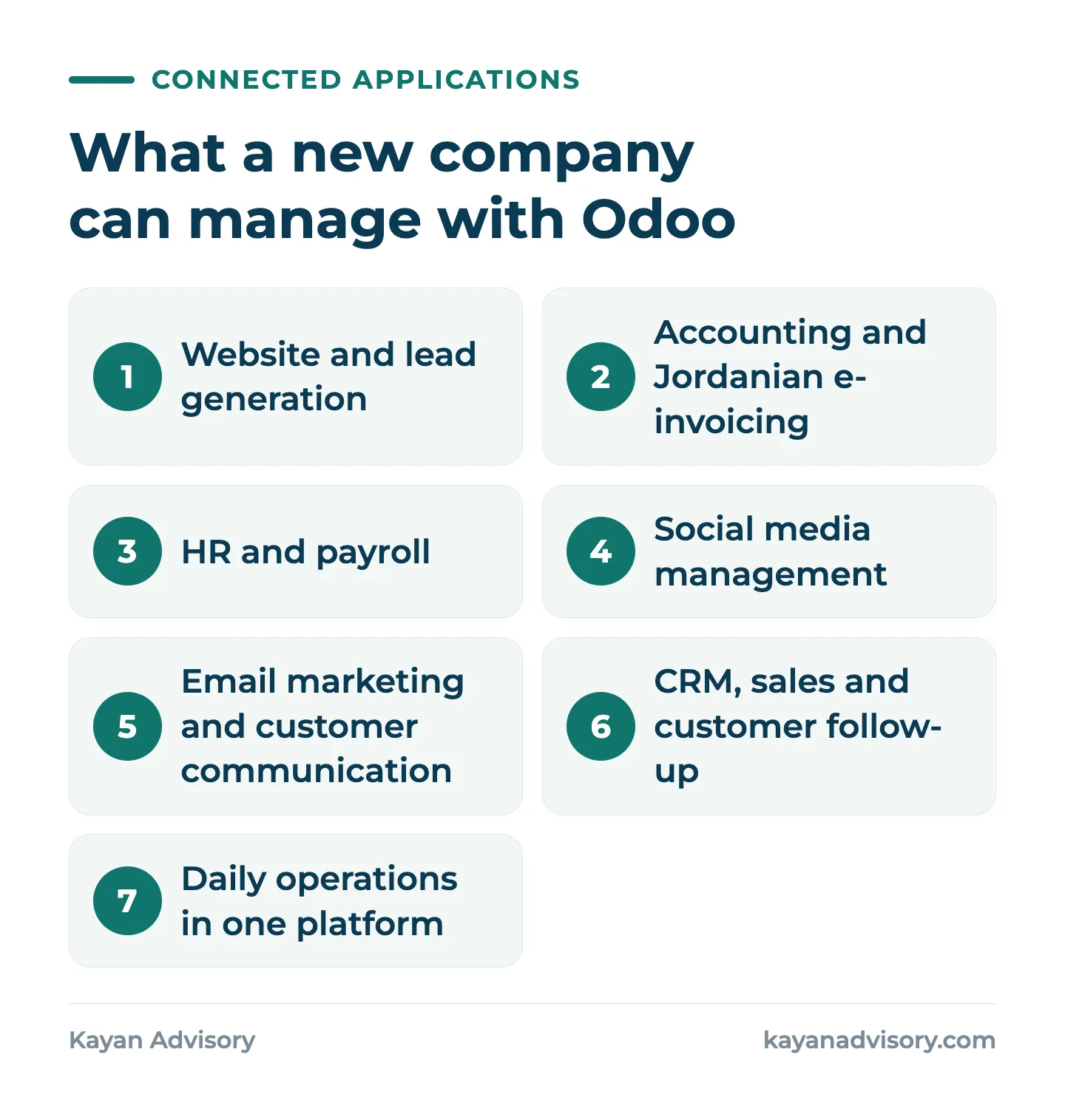
What can a new company manage with Odoo?
1. Website and lead generation
Odoo provides a visual website builder for pages, forms, content and SEO. Odoo’s documentation also states that Odoo Online databases may receive a free custom domain for one year, subject to Odoo’s terms. A new company can begin with essential pages and later connect its website to CRM, appointments or eCommerce.
2. Accounting and Jordanian e-invoicing
Odoo’s Jordanian localization includes a local chart of accounts, tax and reporting configurations, and integration with Jordan’s JoFotara platform. According to Odoo’s official documentation, the integration can generate and submit electronic invoices, track their status and include the validated QR code.
The feature still requires proper configuration. Company and customer data, taxes, accounts, access rights and JoFotara credentials must be reviewed and configured for the company’s circumstances.
3. HR and payroll
Odoo can bring employee records, contracts, attendance, leave, recruitment and payroll into one database. Its Jordan payroll localization includes standard payroll, income-tax and social-security logic and can post payroll entries to accounting when the required applications are installed and configured.
Marketing, customer management and connected operations
Odoo can support much more than accounting. A small company can start with the tools it needs today, then activate additional applications as the team and transaction volume grow.
4. Social media management
The Social Marketing application can help a company create and schedule posts, manage supported business social-media accounts, monitor streams, analyze content performance and engage with followers from one central workspace. Supported connections and functionality depend on each platform’s API and the company’s account permissions.
5. Email marketing and customer communication
Odoo Email Marketing includes drag-and-drop campaign design, reusable templates, mailing lists, unsubscribe management and performance metrics such as delivery, opens and clicks. When connected with CRM and the website, enquiries can move from a form or campaign into a structured sales follow-up process.
Email Marketing is a campaign tool; it should not be presented as a complete replacement for a business mailbox such as Microsoft 365 or Google Workspace. Companies that need named corporate mailboxes should confirm the appropriate email-hosting and domain configuration separately.
6. CRM, sales and customer follow-up
Odoo can organize leads, opportunities, quotations, sales orders, invoices, appointments and customer activities in one workflow. This helps founders and managers reduce missed follow-ups and see where each opportunity stands.
7. Daily operations in one platform
Depending on the company’s needs, Odoo can also cover purchases, inventory, expenses, projects, timesheets, approvals, documents, electronic signatures, recruitment, leave, helpdesk, eCommerce and point of sale. The objective is not to activate every application on day one, but to build a connected system that can grow without recreating the company’s data in separate tools.
What can a new business owner gain in practice?
1. A professional market presence from the start
The founder can build a branded website, publish services, collect enquiries through structured forms and allow prospects to book appointments. The website does not have to remain a separate brochure; it can become the front door to CRM, sales and customer follow-up.
2. One organized view of customers and opportunities
Instead of searching through personal messages, spreadsheets and inboxes, the owner can record leads, assign activities, track proposals and see which opportunities need attention. This creates a clearer sales pipeline and reduces dependence on memory.
3. A shorter path from quotation to collection
Quotations, sales orders, invoices and payment follow-up can be connected. Once information is entered, it can move through the process without being typed again into several files, subject to the company’s configured workflow and controls.
4. Financial visibility for better decisions
Accounting, bank reconciliation, expenses, budgets and management reports can be brought into a consistent structure. The owner can review receivables, payables, cash position, sales performance and financial results using information drawn from the same operating records.
5. Better control over spending and approvals
Expense claims, purchase requests and internal approvals can follow defined responsibilities. This helps the owner know what was requested, approved, purchased and paid, rather than discovering commitments after the fact.
6. A more organized employee experience
Employee records, contracts, attendance, leave, recruitment, expenses and payroll can be managed within coordinated applications. The owner gains better visibility over responsibilities and employment information while employees follow clearer processes.
7. Marketing that connects to business development
Website forms, social-media activity, email campaigns and CRM can support one customer-acquisition process. Management can compare campaigns, monitor follow-up and understand which activities are generating useful enquiries instead of looking only at likes or impressions.
8. A platform that can grow with the company
A new business may begin with a website, CRM, invoicing and accounting, then add payroll, inventory, projects, helpdesk or eCommerce when needed. The company keeps a common data foundation instead of replacing its entire system at every stage of growth.
A practical first 90-day roadmap
Days 1–30 — Build the foundation
Confirm company information, users and access rights; prepare the website and lead form; configure the basic chart of accounts, taxes, journals, quotations and invoices; and define who owns each core process.
Days 31–60 — Establish control
Introduce expenses, approvals, bank reconciliation, payroll or project tracking as required. Review the quality of master data and begin producing regular management information.
Days 61–90 — Improve and automate
Connect marketing activities, refine dashboards, remove duplicate manual steps and add carefully selected automations. The objective is to improve the process after it is understood, not automate confusion.
Why can this remain cost-effective?
A small company can begin with a limited number of paying internal users and activate the applications it genuinely needs. Because the Standard plan includes all Odoo applications on Odoo Online, the company may avoid paying separate subscriptions for a website builder, CRM, email campaigns, accounting, projects and other tools. The actual saving depends on the systems being replaced, user count and implementation scope.
Cost discipline still matters. A clear chart of accounts, clean data, defined responsibilities and a realistic implementation scope are more valuable than activating every feature. Kayan’s offer for the first 10 qualifying companies reduces the initial professional setup cost for one selected starter package.
What does an Odoo subscription cost approximately?
Odoo’s official pricing page currently displays the Standard plan, with yearly billing, at a promotional US$7.25 per paying user per month for the first 12 months for the initial users ordered. That equals approximately US$87 per user for the first year. The page also displays a regular yearly-billing reference price of US$8.95 per user per month, or approximately US$107.40 per user per year.
Illustrative first-year Standard plan examples:
- 1 paying user: approximately US$87 per year.
- 3 paying users: approximately US$261 per year.
- 5 paying users: approximately US$435 per year.
The Standard plan includes all Odoo applications on Odoo Online. The Custom plan is currently displayed at a promotional US$10.90 per user per month with yearly billing and adds features such as Odoo Studio, multi-company and external API access.
These examples exclude taxes, implementation services, custom development, Odoo.sh hosting and other optional services. Currency, regional pricing, promotions and Odoo terms can change. Companies should always confirm the final quotation on Odoo’s official pricing page before subscribing:
No. Odoo currently offers a One App Free plan on Odoo Online with unlimited users. Using several major applications together — for example Website, Accounting, HR, CRM, Social Marketing and Email Marketing — generally requires an appropriate paid plan.
Kayan’s complimentary package covers one defined starter implementation service. It does not cover Odoo subscription fees.
Kayan Advisory will provide one complimentary starter setup package to the first 10 qualifying new or small companies that begin a new paid Odoo subscription through Kayan’s official referral link, or until 30 September 2026, whichever comes first.
Each qualifying company may choose one of the following:
1. Starter website setup: one language, up to five core pages, contact form, basic responsive setup and domain connection where available.
2. Accounting foundation: Jordan localization, a standard chart of accounts for one activity, core journals and taxes, initial JoFotara setup guidance and a short handover session.
3. Payroll foundation: Jordan payroll localization, a standard payroll structure for one entity and up to 10 employees, work schedules, basic contracts, standard payroll rules and a short handover session.
Scope and eligibility
- The offer is for new and small companies starting a new paid Odoo subscription through Kayan’s official link.
- It covers one legal entity and one starter package.
- The client must provide the required information, content and documentation on time.
- Custom development, extensive migration, data cleansing, external integrations, extended training and ongoing support are excluded.
- Additional requirements may be quoted separately after client approval.
- Odoo subscription fees remain payable to Odoo under its current pricing and terms.
- Disclosure: Kayan Advisory receives no referral commission on Odoo subscriptions until ten companies have subscribed through our official link. Once that number is reached, it receives a referral commission on subsequent subscriptions. Use of the link does not add a separate Kayan charge to Odoo’s published subscription price.
- The offer does not guarantee regulatory compliance; each company’s configuration and obligations must be reviewed according to its specific circumstances.
How to start
1. Contact Kayan Advisory for a short qualification call.
2. Begin your paid Odoo subscription through Kayan’s official referral link.
3. Send the subscription confirmation and basic company information.
4. Agree the package scope and implementation schedule with our team.
Disclaimer: This content is provided for general information. The suitability of Odoo, required applications and implementation scope depends on each company’s circumstances. Odoo plans, pricing, features and terms are subject to change by Odoo.